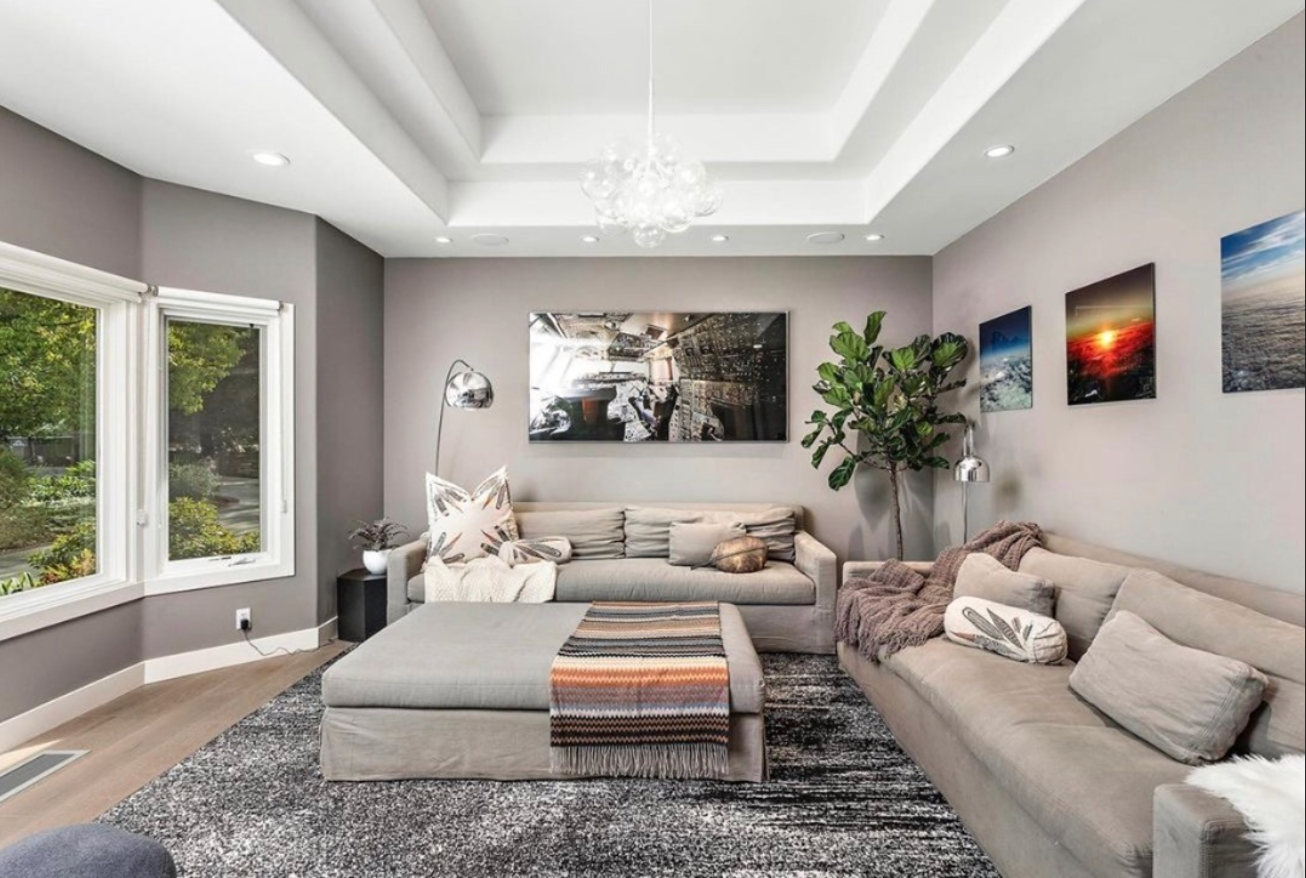
Lately I’ve been noticing more and more conversations about how homes have started to feel a little… boring. And honestly, I get it. Take a scroll through Instagram and you’ll see it immediately. Beautiful homes, perfectly styled, and somehow all starting to look the same. Calm, clean, pristine… but missing something important.
We’ve sacrificed personality and playfulness on the altar of trends and resale value. For years, we’ve been taught to choose what appeals to everyone and stay within a palette that feels universally “beautiful.” But somewhere along the way, it’s easy to lose the parts of a home that actually make it feel like yours.
When we moved into our home here in the Pacific Northwest, I kept pulling inspiration from those beautiful California coastal interiors. You know the ones. Soft, neutral, calm. I loved how they looked, and I really thought that was the direction I wanted to go (even though, realistically, a white couch with a toddler was… ambitious).
But when I actually started implementing it, I kept pivoting. I’d add color. Layer in something unexpected. And at the time, I was honestly a little frustrated with myself because I couldn’t seem to stick to the plan. Also, let me reiterate, I’m a lighting designer, not an interior designer.
Over time, though, I realized I wasn’t doing it wrong. I was just designing a home that actually reflected me. What I ended up with is a slightly eclectic, collected, pulled-back vintage feel. It’s layered, a little unexpected, and definitely not what I thought I was going to create, but now I can’t imagine it any other way.
Our navy walls, a chartreuse velvet sofa, and a red rug all somehow live together, and it makes my heart sing. It feels like us.
I think that’s why this idea of whimsy, and dare I say weird, is resonating so much right now. People are starting to move away from perfect and toward personal. Toward spaces that feel lived in, expressive, and a little more interesting. Not chaotic. Not overdone. Just more alive and reflective of what makes us joyful.
Whimsy Through Repetition
For those of you who think whimsy is grandmas ceramic owl collection, let's dial it in a bit.
Whimsy comes in many forms - Designer Deborah Pinion (@DeborahPinionInteriors) shows this beautifully, especially in how she works with pattern. In the bedroom pictured below, the wallpaper wraps the entire room, and you see that same pattern language echoed in the window treatments and surrounding textiles. Everything lives in a very soft, restrained palette, so even though there’s quite a bit going on, it never feels busy.

Styling @anthony_amiano
Shown: 31 Bubble Chandelier in violet and hand-frosted bubbles
Amazing, right?! Your eye just moves through the space.
And that’s what makes it work. It’s layered, but it’s consistent. Nothing feels random or added as an afterthought.
The chandelier continues that story. The violet and frosted glass bubbles pick up those same tones again, but in a different form. It doesn’t introduce something new so much as reinforce what’s already there, which makes the whole room feel cohesive.
That’s the key with this kind of whimsy. It comes from committing to an idea and carrying it through, not from adding one playful element and hoping it pulls everything together.
Whimsy Through Restraint
If you fall closer to the minimalist end of the spectrum, Holly at Studio HP Design (StudioHPDesigns) is your North Star. Her work is moody, tonal, and refined. The palette is controlled, the architecture is doing a lot of the work, and everything feels incredibly intentional. And then there’s a shift.
In this space, it’s a clear bubble chandelier set against deep blue walls and traditional detailing. The fixture doesn’t overwhelm the room or block the view, but it also doesn’t disappear. It introduces just enough movement and softness to change how the space feels, and that contrast is what creates the whimsy.

Shown: 31 Bubble Chandelier with clear bubbles
It’s not about adding more. It’s about choosing one unexpected element and placing it exactly where it will have the most impact. Holly does this so well across her work. There’s always something slightly offbeat, but it’s done in a way that feels completely intentional.

The gold drip. Standing ovation Holly. May we all have the courage to add a drip to something in our lives.
Whimsy Without Restraint
(Minimalists, beware or be inspired?)
And then there’s the other end of the spectrum entirely.
New York designer Megan Hopp’s (@MeghanHopp) work is a masterclass in going all in. This is not subtle, and it’s not meant to be. We’ve all heard of color drenching, but what about pattern drenching? Multi-pattern drenching?
Honestly, her work blows my mind. How do all of these patterns, colors, shapes, textures, and textiles work together and not feel chaotic? It shouldn’t work, and somehow it absolutely does.

Photography by @kelseyannroseinteriors

Shown: Branch Bubble Chandelier with iridescent bubbles and brass hardware.
Megan layers bold color, strong pattern, varied scale, and sculptural forms all at once, and everything still feels connected. Your eye moves through the room without getting stuck, even though nearly every piece is making a statement. That’s not accidental. It’s a very clear point of view carried all the way through, with a large dash of mad genius.
That’s what makes this kind of maximal approach feel cohesive instead of overwhelming. It’s not about adding more for the sake of it. It’s about feeling exactly what you’re trying to create and following that idea all the way through.
And this is the part that gets missed the most.
Whimsy isn’t something you can create in an afternoon. It’s not going out and buying something “fun” and placing it on a shelf so your home feels more interesting. That almost always feels forced.
The spaces that really work are built over time. They’re layered with pieces you’ve collected, things you’ve found on trips, artwork that resonated with you, and finishes that feel like you. It’s slower and more intentional, but it’s also what makes a space feel personal instead of styled.
Where Lighting Fits In
As a lighting designer, I feel (obviously) very strongly that lighting can make or break a space. It’s not about choosing something that simply works. It’s about finding something that actually belongs.
I was on a call recently with a client moving into a new home, and her kitchen was incredible. Open, layered, with a terrazzo backsplash, teal cabinetry, and a mix of bold and refined elements. The existing fixture technically worked. It matched. It didn’t clash. But it didn’t say anything.
So we started looking more closely at her cabinet color, her hardware, her materials, and how everything interacted. From there, we were able to dial in a fixture that actually connected to the room and reflected her. That’s the difference. It’s not just about matching. It’s about creating something that feels intentional.
Decision fatigue is real, and I think a lot of people end up settling for “good enough” lighting when it could be the thing that actually pulls the entire room together.
At the end of the day, the goal isn’t to make your home louder or trendier. It’s to make it feel more like you. And usually, that comes down to a handful of thoughtful decisions—pieces that feel just unexpected enough to bring everything to life.
So if your space is feeling a little too safe, a little too expected, this is your permission to shift. Lean into what you love. Choose the color. Mix the pattern. Go a little further than feels comfortable.
Because the homes that feel the best are never the ones that played it safe. They’re the ones that made room for a little bit of whimsy.
And if nothing else, maybe this is your sign to try something just a little unexpected.
If you’ve been thinking about this too, a few pieces I loved reading recently:
Do the Things in Your Home Truly Bring You Joy? — Emily Henderson
A good reminder that the things we live with every day should actually make us happy, not just look good.
Designers Say Our Homes Aren’t Weird Enough — House Beautiful
This one really gets at the idea of playing it too safe and why a little personality goes a long way.
How to Add More Whimsy to Your Life This Year — Gretchen Rubin
Less about design, more about mindset—but it’s a great push to start noticing what brings you joy and actually leaning into it.